
What Is a Court Docket in Webb County
A docket is the dated log of everything that happens in a case. It lists filings, hearings, orders, and settings in the order they occur. In Webb County, a docket entry might note a petition filed, a citation issued, an answer, a motion, a hearing set, or a judgment signed. The docket is the map of a case. It tells you what has happened and what comes next.
A docket is not the full case file. The docket is the list of events. The full file holds the actual documents, such as the petition, the motions, the exhibits, and the signed orders. A court calendar is a related tool that lists upcoming settings by date, court, and case. People often use the docket to confirm a hearing date or to see whether a ruling has come down.
How to Find Webb County Dockets Online
Start at the Webb County Odyssey Public Access portal at publicaccess.webbcountytx.gov. The landing page lets you pick Court Calendar to look at scheduled settings, or pick a case category to open the docket inside a case. Search by case number when you have it, or by party name. The calendar view is useful for finding a hearing date, court, and judge.
- Open the Webb County Public Record Search.
- Choose Court Calendar, or pick a case category to view a case docket.
- Enter a case number or a party name.
- Open the result and read the docket entries and any hearing settings.
Calendar records do not replace the case file. They tell you when a case is set, but you still confirm with the court coordinator if a setting is unclear. The County Court at Law II page links a court docket and forms directly, which is a handy court-level option. The screenshot below shows that court's page.
See the Webb County Court at Law II page, which links its docket and forms.
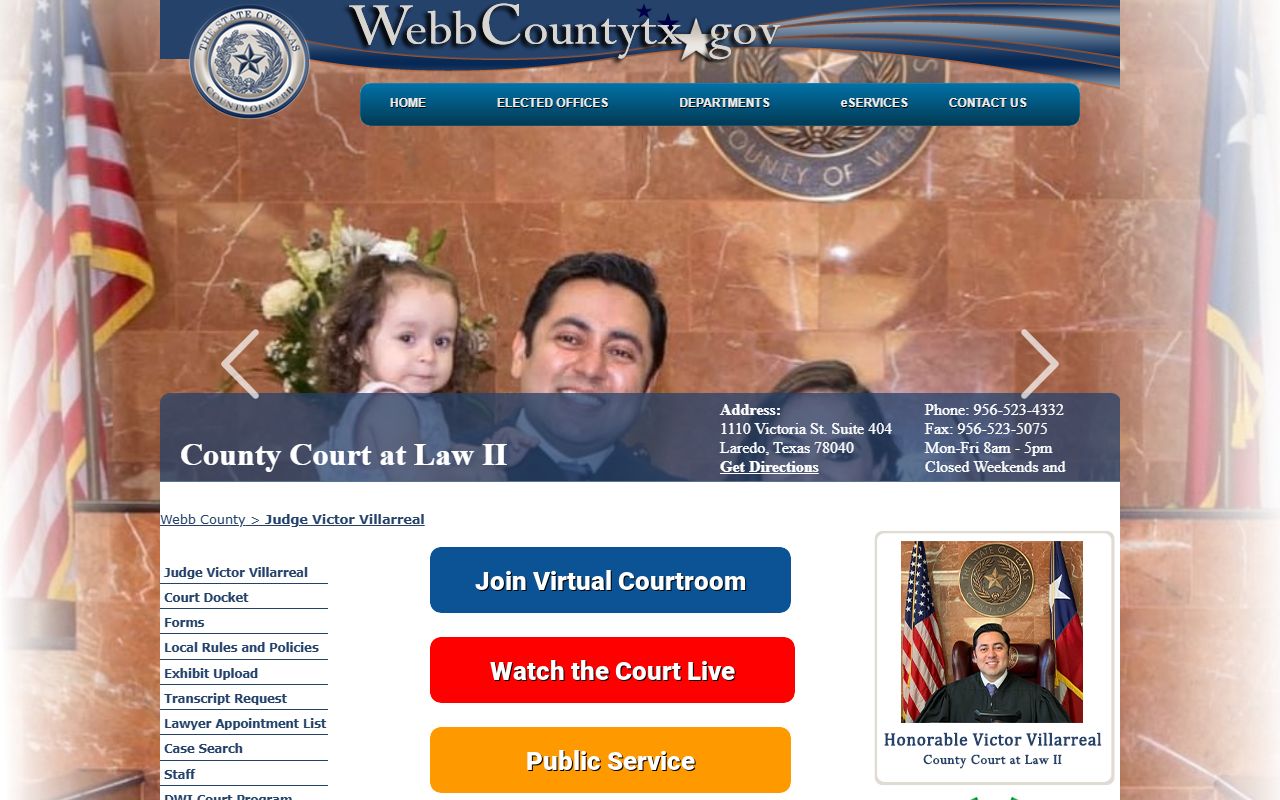
Court-level pages like this one fill the gap when the central calendar does not show every local setting.
Sample Webb County Docket Entry
Each docket line packs several pieces of information. It tells you when something happened, what it was, who filed it, and whether a document is attached. Reading these fields in order lets you follow a case without opening every paper. Here is what a typical entry holds.
| Field | What It Shows |
|---|---|
| Entry Date | The date the filing, hearing, or order was recorded. |
| Event Type | The kind of event, such as petition filed, motion, hearing, or judgment. |
| Party Filing | Which side filed the document or requested the action. |
| Hearing Setting | The date, time, and court for an upcoming hearing, if one is set. |
| Document Link | Whether a copy is attached, and if it is free, fee-gated, or blocked. |
Note: Webb County's online portal may show an entry without the attached document, so a certified copy still comes from the District Clerk or County Clerk.
Courts That Publish Dockets in Webb County
Webb County's trial courts feed the same public access system, but the depth of online detail varies. District courts post case and calendar data through Odyssey. County courts at law do the same and also link their own docket pages. Justice courts handle smaller matters and may share calendar detail by phone or in person. The Laredo Municipal Court is separate and is not part of the county docket system.
- District courts (49th, 111th, 341st, 406th) - felony, civil, and family settings through Odyssey.
- County Courts at Law I and II - civil, family, probate, and some criminal dockets.
- Justice of the Peace courts - small claims, eviction, and traffic settings by precinct.
Docket vs. Full Case Record
People mix up the docket and the case file, but they do different jobs. The docket is a quick list you use to track progress. The full record holds the documents you need for legal review or evidence. The table below lays out the difference.
| Docket | Full Case Record | |
|---|---|---|
| Format | List of dated entries | Full filed documents |
| Access | Often online and free | May need a fee or a clerk visit |
| Use | Track case progress and dates | Legal review, copies, evidence |
For the documents behind the entries, see Webb County court records.
In-Person and Remote Hearing Rules
Whether a setting is in person or by video depends on the court. The 111th District Court says pending matters are in person, effective September 1, 2022, unless the court orders otherwise. The 406th District Court runs hybrid hearings and may let counsel and parties appear by Zoom when arranged with the court coordinators, with public observation usually in person for scheduled cases.
The 406th District Court posts clear remote-hearing etiquette: join at least five minutes early, type your full name, speak one at a time so the court reporter can take the record, keep a neutral background, and dress for a formal court setting. The image below shows that public access notice.
Read the 406th District Court public access notice for hearing and observation rules.
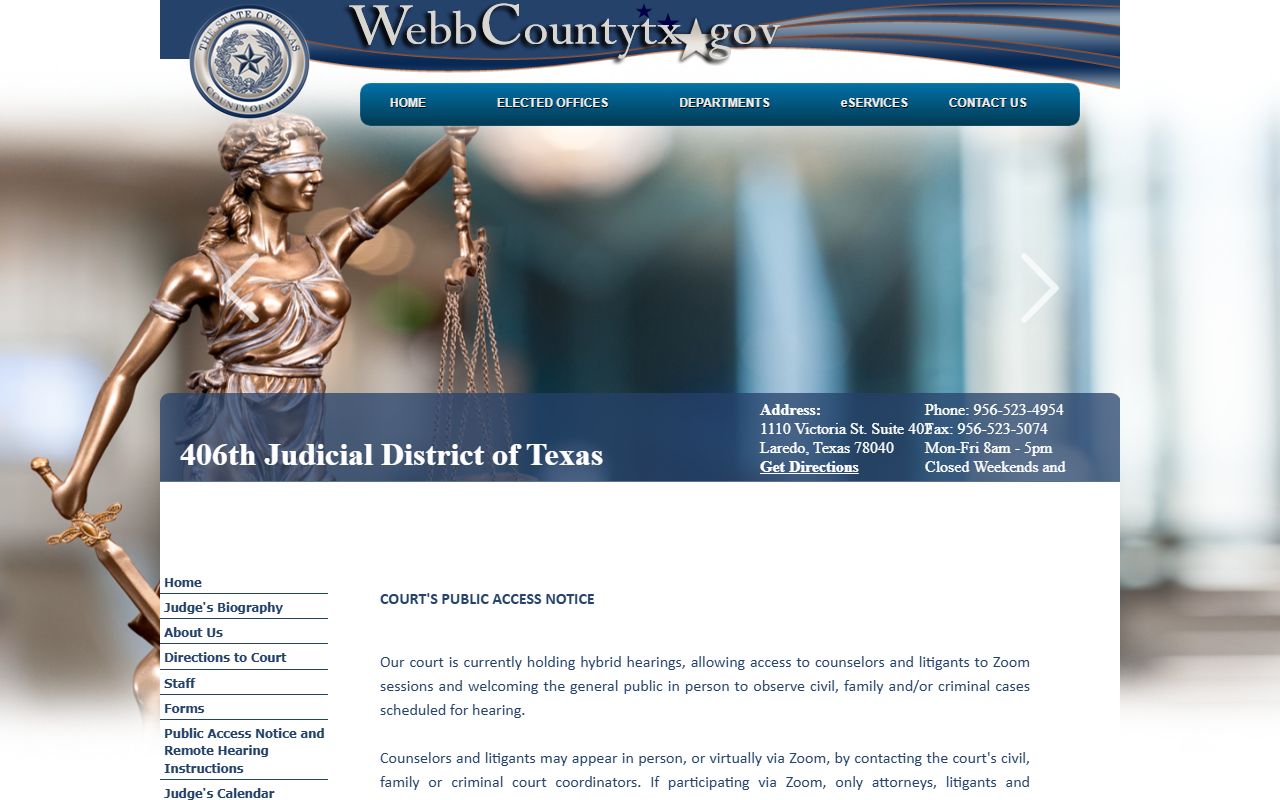
If you plan to watch or join a hearing, check the court's notice and call the coordinator so you follow the current rule.
How to Read a Webb County Docket
Docket shorthand can look like code. A "MOT" is a motion, an "ORD" is an order, and a "JMT" or "JUDG" points to a judgment. A "CONT" marks a continuance, which postpones a setting. A "DISM" notes a dismissal. Dates run down the page in order, so the newest activity is easy to spot at the top or bottom depending on the sort.
Watch the disposition line. "Dismissed with prejudice" bars a refiling of the same claim. "Dismissed without prejudice" may allow one. "Deferred adjudication" means the court held off on a guilty finding while a person completed supervision. If a docket entry is unclear, the court coordinator can explain the status without giving legal advice.
Criminal and civil dockets read a little differently. A criminal docket tracks arraignment, plea, pretrial settings, and sentencing. A civil or family docket tracks the petition, service, answer, hearings, mediation, and the final order or decree. The 406th District Court keeps a Pro Se Divorce Docket for self-represented parties, and the county runs a Social Justice Night Court for uncontested matters, so some dockets carry their own special settings.
Contacting a Webb County Court Coordinator
Each Webb County court has a coordinator who manages its calendar. When a docket is unclear, the coordinator is the person to call. They can tell you the setting date, the court, and the case status, and they can explain how to ask for a continuance or a reset. They cannot give legal advice, fill out a form for you, or tell you what to say in court. Those limits come straight from the county's own pro se guidance.
Webb County's 341st District Court pro se sheet spells out what staff may and may not do. Staff may explain how the court works, give general procedure information, share schedules, and point you to forms and resources. The 111th District Court lists a criminal court coordinator and a civil court coordinator for case questions, and the 406th District Court lists separate civil and criminal docket coordinators. Reach the right one through the court's official page.
- Schedules and settings - the coordinator confirms hearing dates and courtrooms.
- Resets and continuances - ask the coordinator how the court handles a request.
- Case-file information - public docket details are available without legal advice.