
Active Warrants in Webb County
Several offices issue warrants in Webb County. The District Clerk is authorized to issue process, including capias and warrants, on behalf of the district courts. The 49th District Court's clerks note that documents such as citations and warrants are served mainly by the Sheriff's Department and Webb County constables. Justice of the peace and municipal courts issue their own warrants for traffic and Class C matters.
Webb County does not publish a single public list of every active warrant in the official pages reviewed. A warrant may surface when a person is booked into the jail, when a court file is searched, or when the sheriff acts on it. Because there is no county-wide warrant database open to the public, the practical search uses the jail and bond records plus a call to the issuing court.
Types of Warrants in Webb County
Not every warrant means the same thing. Some come from a new criminal charge. Others come from a missed court date or an unpaid fine. The list below covers the kinds you are most likely to run into in Webb County.
- Arrest warrant - issued on probable cause to take a person into custody for an offense.
- Bench warrant or capias - issued for a missed court date, contempt, or a step in a case.
- Capias pro fine - a traffic or Class C warrant after a judgment when a fine is not paid.
- Search warrant - authorizes a search of a place or property, often sealed until it is executed.
- Writ of attachment - used in some family and civil matters to bring a person before the court.
How to Search Webb County Warrants
Start with the Webb County Jail and Bond Record Search on the sheriff's page. If a warrant has led to a booking, the person and bond may show there. If nothing shows, the next step is the issuing court. Identify the court from any citation or case paper, then call the clerk or coordinator to ask about a warrant, the bond, and what to do next.
- Check the Webb County Jail and Bond Record Search for a booking.
- Identify the issuing court: district, county court at law, justice, or municipal.
- Call that court's clerk or coordinator about the warrant, bond, and appearance.
- For a JP traffic warrant, contact the precinct; JP 1-2 takes citation payments by phone.
For warrants tied to the 406th District Court, law enforcement officers can set an appointment to submit arrest or search warrants for the judge's review through the court bailiff. The general public should not rely on a private background website for warrant status.
Webb County Jail and Bond Search Fields
The closest official search tool is the Jail and Bond Record Search, an Odyssey jail-records interface. It is not a dedicated warrant list, but it shows custody and bond when a warrant has resulted in a booking. The fields below are what the public jail search uses.
| Field Label | Type | Required | Notes |
|---|---|---|---|
| Last Name | Text | Yes | At least one name field is needed. |
| First Name | Text | No | Used to narrow common names. |
| Booking Number | Text | No | Most exact match when known; verify field live. |
Note: A clear jail-search result does not rule out a warrant from another court, since not every order leads to a booking.
What a Webb County Warrant Record Shows
No official public sample warrant listing was found for Webb County, but warrant records generally carry a standard set of fields. When you reach the issuing court, these are the details to ask about and confirm.
| Field | What It Shows |
|---|---|
| Warrant Number | The unique ID assigned to the warrant. |
| Issue Date | The date the court signed the warrant. |
| Charge / Offense | The offense or reason behind the order. |
| Warrant Type | Arrest, bench, capias, capias pro fine, or search. |
| Bond Amount / Type | The bond set, if any, and whether it is cash or surety. |
| Issuing Court | The court that signed and holds the warrant. |
What to Do If You Have an Outstanding Warrant
Take it seriously and move quickly, but carefully. First, find out which court issued the warrant. Call that court's clerk or coordinator to learn the warrant type, any bond, and whether a court date or payment can clear it. For a traffic or Class C warrant, the justice court may let you pay or set a hearing. If you are already in custody, the jail and bond search shows bond status.
Important: For a felony, family-violence, probation, or contempt warrant, talk to a lawyer before you turn yourself in or speak with the court.
The Warrant Enforcement Division
Webb County set up a Warrant Enforcement Division through the 406th District Court to help the courts enforce arrest warrants and writs of attachment for people who fail to appear. It is one of several programs the court runs, alongside drug court, the veterans program, and a pro se divorce docket. The image below shows the 406th programs page.
See the 406th District Court programs page for the Warrant Enforcement Division and related dockets.
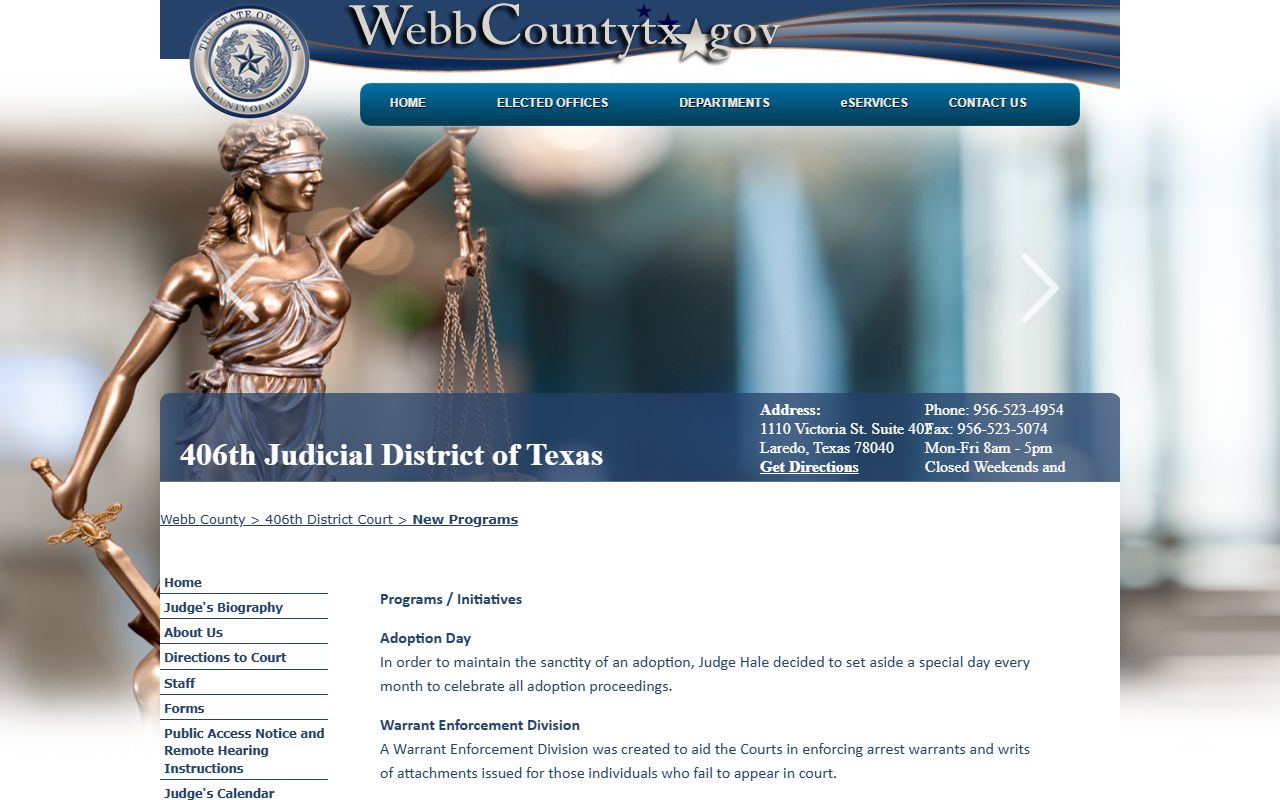
This division shows that a missed court date can turn into an active warrant, so it pays to resolve a setting before it escalates.
Justice Court and Traffic Warrants
Many Webb County warrants are not felonies at all. They are capias pro fine warrants from unpaid traffic tickets or Class C fines in the justice courts. Each justice of the peace court handles its own. JP 1-2 publishes civil and criminal information, including peace bonds and traffic, and takes citation payments by phone. The image below shows that JP page.
Review the JP 1-2 civil and criminal information page for traffic, peace bond, and fine details.
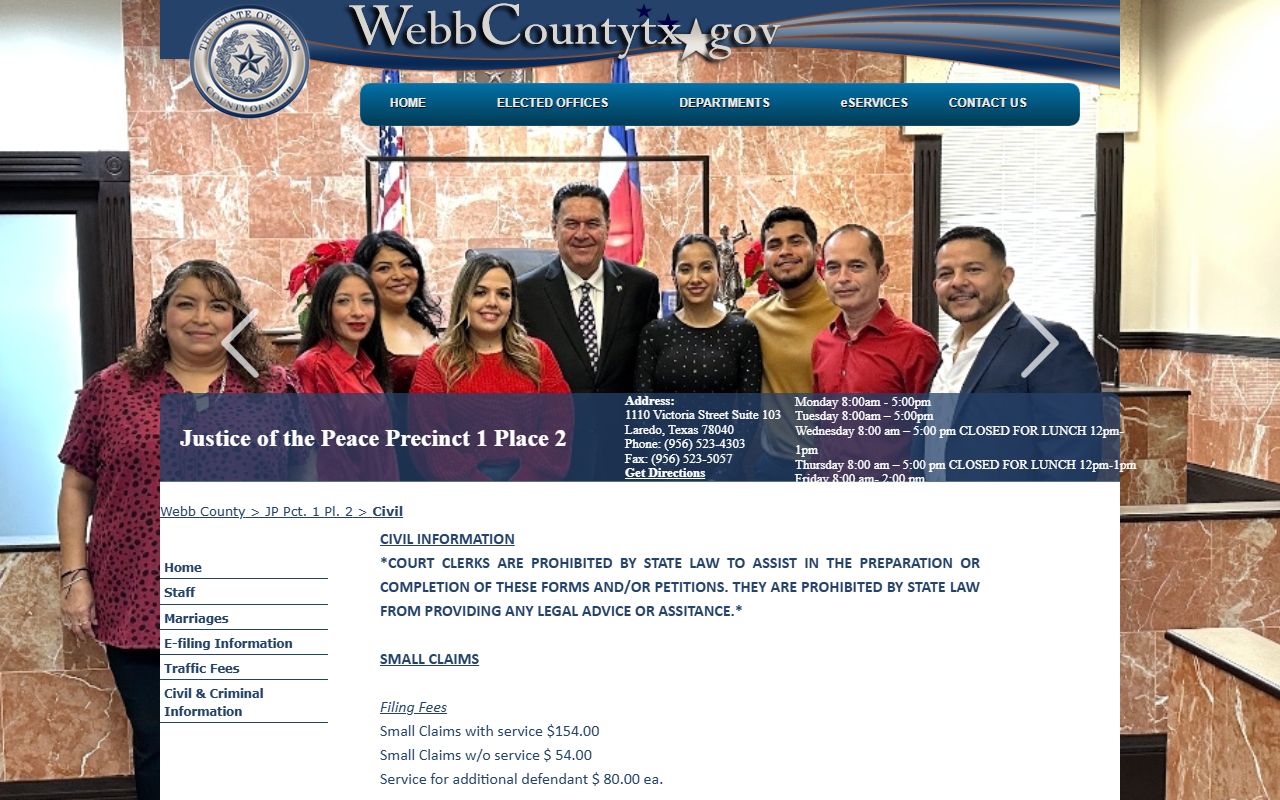
If your warrant ties to a ticket, the precinct that issued it is the office that can clear it, often without a court appearance.
Restricted Webb County Warrant Records
Some warrants are not public. A search warrant is often sealed until it is executed and returned, and some stay sealed longer. Juvenile warrants follow the confidentiality rules for youth records. Federal warrants are not in the county system at all. Because of these limits, a quiet public search is never proof that no warrant exists, so confirm with the issuing court or a lawyer.
Bond and Appearance After a Warrant
Many warrants come with a bond, which is money or a promise used to secure release and a return to court. Texas bail rules sit in the Code of Criminal Procedure. A bond can be a cash bond, a surety bond posted through a bonding company, or a personal bond that releases a person on a promise to appear. The amount and type depend on the charge, the court, and any holds. A person with more than one case may face more than one bond, so the jail and bond search is a starting point, not the final word.
After a warrant is cleared by payment, appearance, bond, or court order, ask the court how long clearance takes. A traffic or fine warrant may also trigger a state driver license hold that has to be lifted on its own. The court that signed the warrant is the office that confirms when it is recalled.
The bail framework comes from Texas Code of Criminal Procedure Chapter 17, which governs bonds, sureties, and release decisions.